Does Dry Dog Food Clean Dogs' Teeth? What Helps
Regular kibble is not a toothbrush. Learn when dental diets may help, why daily brushing matters, and when your dog needs a vet.
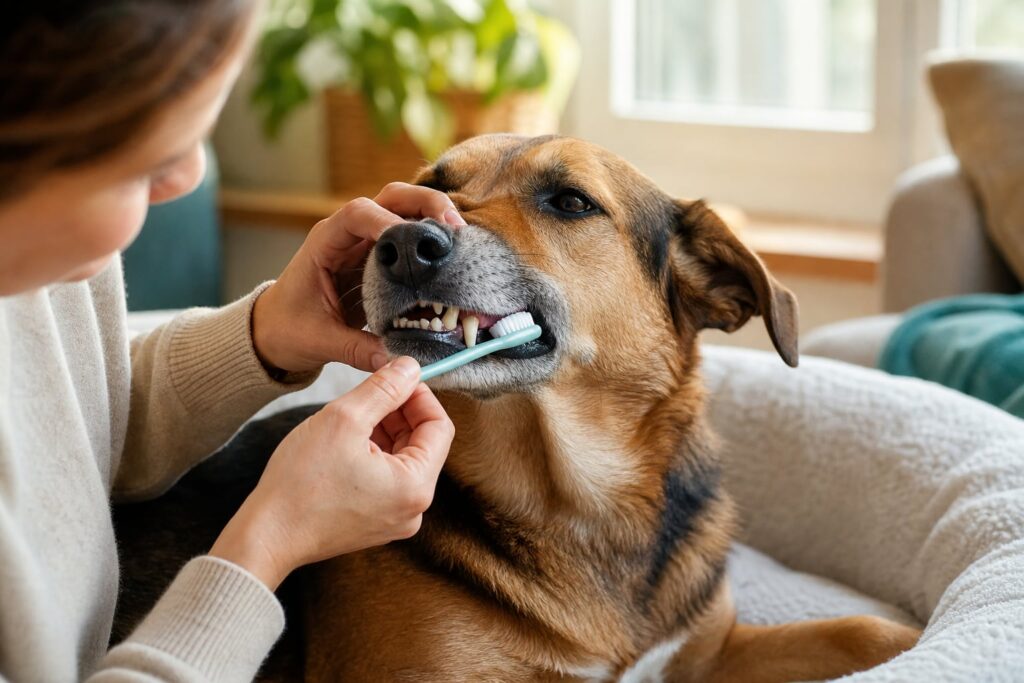
If you have ever chosen a crunchy food partly because you hoped it would protect your dog’s smile, you were trying to make a caring decision. Pet-food advice often turns one small truth into a sweeping promise, and dental health is a perfect example. The question does dry dog food clean dogs’ teeth sounds as if it should have a simple yes-or-no answer. The honest answer is more useful: ordinary dry food should not be treated as a toothbrush, while certain foods designed and evaluated for dental care may help reduce plaque or tartar.
That distinction matters because a dog can finish every crunchy meal and still develop painful disease below the gumline. Food can support an oral-care plan, but it cannot reveal hidden disease, remove established tartar, or replace a veterinary team. The goal is a small routine your dog can tolerate, supported by products whose claims mean something.
The short answer: crunch is not the same as dental care
Most ordinary kibble is made to deliver nutrition conveniently. A dental diet is deliberately made with oral care in mind. According to the American Animal Hospital Association’s dental nutrition guidance, specially designed diets may use a larger piece, a particular texture, or an anticalculus agent to slow the accumulation of plaque or tartar. The useful feature is the specific design and supporting evaluation, not dryness by itself.
This means you do not need to choose your dog’s entire diet from one dental claim. Start with a food that is nutritionally appropriate for the dog in front of you: their life stage, body condition, medical needs, tolerance, and daily routine. Our guide to reading a pet-food label can help you check the nutritional adequacy statement, calories, and feeding purpose before a front-of-pack promise takes over the decision.
If a dry food makes no evaluated plaque or tartar claim, do not assume its crunch is quietly doing the work of a toothbrush. If a dental diet does carry a supported claim, think of it as a helpful tool rather than complete protection. Even a thoughtful diet cannot reach every tooth surface equally or reveal disease hidden below the gumline.
What plaque, tartar, and periodontal disease mean
Plaque is a soft film containing bacteria and material from saliva that forms on teeth. When it is not removed, minerals in saliva can harden it into calculus, commonly called tartar. Plaque at and below the gumline can contribute to gingivitis, while deeper inflammation can damage the tissues and bone supporting a tooth. By then, a mouth that looks merely “a little dirty” may also be painful.
The distinction between plaque and tartar explains why timing matters. The AAHA home-care guidance notes that brushing removes plaque, not established calculus. Once hard deposits or disease are present, trying to scrub harder at home is not the answer. Your veterinarian may need to examine the mouth more fully and recommend professional treatment.
Dental disease is common and can be easy to miss. The AAHA dental guidelines state that most dogs and cats have some level of periodontal disease by three years of age. That does not mean every three-year-old dog has the same problem or needs the same procedure. It means a clean-looking front tooth and normal appetite are not enough to rule disease out.
Ordinary kibble and a dental diet are not interchangeable
A dog may bite a piece of ordinary kibble once, break it, and swallow it. Another dog may barely chew the same food. A dental diet is intended to create more useful contact between food and tooth or to use an ingredient that helps control mineral deposits. The exact mechanism varies, so “crunchy” is too broad a description to predict a dental benefit.
Look for a claim attached to the exact product, not a halo around an entire brand. The Veterinary Oral Health Council’s accepted-products directory lists products by species and identifies whether the accepted claim concerns plaque, tartar, or both. Its dog list includes dental diets as well as chews, water additives, toothpastes, toothbrushes, wipes, and other formats.
A VOHC listing is useful because it gives you a more disciplined question than “Does this package look dental?” It lets you ask, “What outcome was this exact product accepted to help control?” It does not make every accepted item right for every dog. A dental diet still needs to suit the dog’s nutritional needs. A chew still needs to be the correct size, used as directed, counted among daily calories, and offered with appropriate supervision.
If you are considering changing the main diet for oral care, compare the whole food rather than one feature. The broader dog-food selection guide explains why life-stage fit, calorie density, tolerance, and a clear nutritional purpose belong in the decision too. A veterinarian can help weigh those needs when dental disease, food allergy, pancreatitis, kidney disease, or another medical concern complicates the choice.
Wet food is not a dental failure
Owners who feed canned or other soft food are often made to feel that they have chosen against dental health. That is not a helpful way to frame the decision. Veterinary dental guidance emphasizes daily plaque control, regular examinations, and specifically evaluated dental products. It does not turn every dry food into dental care or make every wet food a cause of disease.
A soft food may be chosen for palatability, hydration, calorie planning, or comfort, including for a dog who already finds chewing painful. A dry food may be chosen for convenience, cost, enrichment toys, or preference. Neither format frees a household from looking after the mouth. Choose the nutritionally suitable diet, then build an oral-care routine around the dog you actually live with.
If your dog suddenly avoids hard food, drops pieces, chews on one side, or approaches the bowl and backs away, do not simply swap textures and assume the problem is solved. Softer food may make eating easier, but a change in chewing can be a sign of oral pain and deserves veterinary attention.
What helps a dog’s teeth most at home
The strongest everyday foundation is mechanical removal of plaque. The Cornell University College of Veterinary Medicine describes toothbrushing as the most effective home-care method for preventing dental disease. Daily is the useful goal because plaque returns continually, but a routine only works when it is safe and sustainable for both dog and person.
Home care can include several layers:
- Daily brushing when tolerated. Use a soft brush and a pet toothpaste, and focus first on a calm experience rather than a perfect whole-mouth cleaning.
- An evaluated dental product. A VOHC-accepted diet, chew, additive, toothpaste, brush, or wipe may be a helpful addition or an alternative when brushing is not yet possible.
- Regular veterinary examinations. An awake look can identify concerns, but a complete dental assessment and dental X-rays require anesthesia when your veterinarian determines they are needed.
- Professional treatment for existing disease. Home products can slow new accumulation; they do not safely remove disease beneath the gums or repair a painful, loose, or fractured tooth.
Even daily brushing does not guarantee that a dog will never need professional care. Success is not a dazzling white smile; it is a comfortable mouth, earlier recognition of trouble, and a routine that does not frighten or hurt your dog.
A gentle way to begin brushing
Brushing is easier when it becomes a cooperative ritual instead of a wrestling match. The UC Davis School of Veterinary Medicine’s home-care instructions recommend introducing it gradually. Move at your dog’s pace; one stage may take a day, while another may take a week or longer.
- Choose a quiet moment. Let your dog settle beside you. Touch the cheek briefly, offer praise or another nonfood reward, and stop while the experience is still easy.
- Practice lifting the lip. You do not need to force the mouth open. Lift one side for a second, release, and reward calm behavior.
- Introduce pet toothpaste. Let your dog investigate a tiny amount. Do not use human toothpaste; ingredients intended to be spat out may upset a dog’s stomach when swallowed.
- Touch a few outer tooth surfaces. Start with a finger wrapped in gauze or the tool recommended by your veterinary team. Keep the session brief.
- Add a soft toothbrush. Brush the outside surfaces gently near the gumline. A few cooperative seconds are more valuable than forcing a long session.
- Build toward a daily habit. Attach the routine to something predictable, such as your own evening toothbrushing, and finish with praise, play, or a walk.
Stop if your dog shows pain, escalating fear, bleeding, or a sudden refusal that is out of character. Inflamed gums can hurt, and brushing a painful mouth can teach a dog that the brush predicts discomfort. Ask a veterinarian to check the mouth before trying again. If safe brushing remains unrealistic, discuss which passive products could provide useful support without damaging trust.
Choose chews for teeth, not toughness
A chew does not become a better dental product because it feels nearly indestructible. Cornell warns that hard objects, including bones, antlers, hooves, and hard manufactured toys, can wear or fracture teeth. Some chews can also create choking, digestive injury, or obstruction risks. Your dog’s enthusiasm is not proof that an object is safe.
Choose products made for dental use rather than improvising with hard objects. Use the correct size, supervise chewing, remove pieces that become small enough to swallow, and follow the product instructions. A dog who gulps instead of chewing may need a different option entirely.
Dental treats also carry calories. If one becomes a daily habit, count it within the food plan rather than quietly adding it on top. For a small dog or a dog managing weight, those calories can matter. If a dog is on a controlled elimination diet or therapeutic diet, ask before introducing a flavored chew; an extra ingredient can interfere with the purpose of the feeding plan.
Know when the mouth needs a veterinarian
Bad breath is easy to joke about, but a persistent or worsening odor can accompany dental disease. Cornell advises contacting a veterinarian for signs including difficulty eating or reduced appetite, bleeding from the mouth, swelling of the jaw or face, drooling, and nasal discharge. A broken or loose tooth, obvious mouth pain, or a sudden change in chewing also deserves attention.
Seek urgent help if facial swelling affects breathing, bleeding will not stop, your dog collapses, or they cannot eat or drink. Do not give human pain medicine unless a veterinarian has specifically prescribed it for that dog. Do not scrape tartar with a household dental tool; a clean-looking crown does not treat disease under the gumline and a slip can injure the dog or the person holding them.
A proper veterinary dental procedure is more than polishing visible teeth. When indicated, anesthesia allows the team to examine each tooth, probe around the gums, take dental X-rays, clean above and below the gumline, and treat painful disease. Your veterinarian can explain the expected benefit, individual anesthetic considerations, home care afterward, and when reassessment is appropriate.
A realistic plan for the next seven days
You do not need to rebuild your dog’s routine tonight. Lift the lip in good light and notice odor, redness, broken teeth, heavy deposits, or discomfort without prying the mouth open. If anything looks painful or your dog resists unexpectedly, arrange an examination instead of starting a cleaning project.
If the mouth appears comfortable and your dog permits handling, practice one tiny brushing step each day. Check whether any current dental product appears in the VOHC directory and what claim it carries. Count chews in the daily calories. Put very hard objects aside. At the next veterinary visit, ask what the team sees, whether professional care is due, and which home routine fits this dog.
Dry food can be a convenient and nutritionally appropriate choice. A specifically designed dental food can be a useful part of oral care. Neither deserves the burden of being your dog’s toothbrush, dentist, and treatment plan all at once. The loving choice is simpler: use food for the job it can do, remove plaque gently and regularly when your dog allows it, and ask for help before a sore mouth has to shout.
Sources
- American Animal Hospital Association: 2019 Dental Care Guidelines for Dogs and Cats
- American Animal Hospital Association: the role of nutrition in dental health
- American Animal Hospital Association: home oral hygiene and product guidance
- Cornell University College of Veterinary Medicine: dental disease and home dental care
- UC Davis School of Veterinary Medicine: dental home-care instructions
- Veterinary Oral Health Council: accepted products
Keep exploring
Next reads and tools
Next route
Browse products
Move from article context into real formula review when you want to compare options.
Open routeIngredient context
Inspect ingredients
Use the ingredient library when one concept in the article needs label-level context.
Open routeTrust boundary
Review methodology
See how scoring, interpretation, and explanation boundaries work across the platform.
Open route