Raw Cat Food and Bird Flu: A 2026 Safety Guide
Can cats get H5N1 from raw food? Check current FDA guidance, warning signs, affected lots, and calm steps to protect your cat.
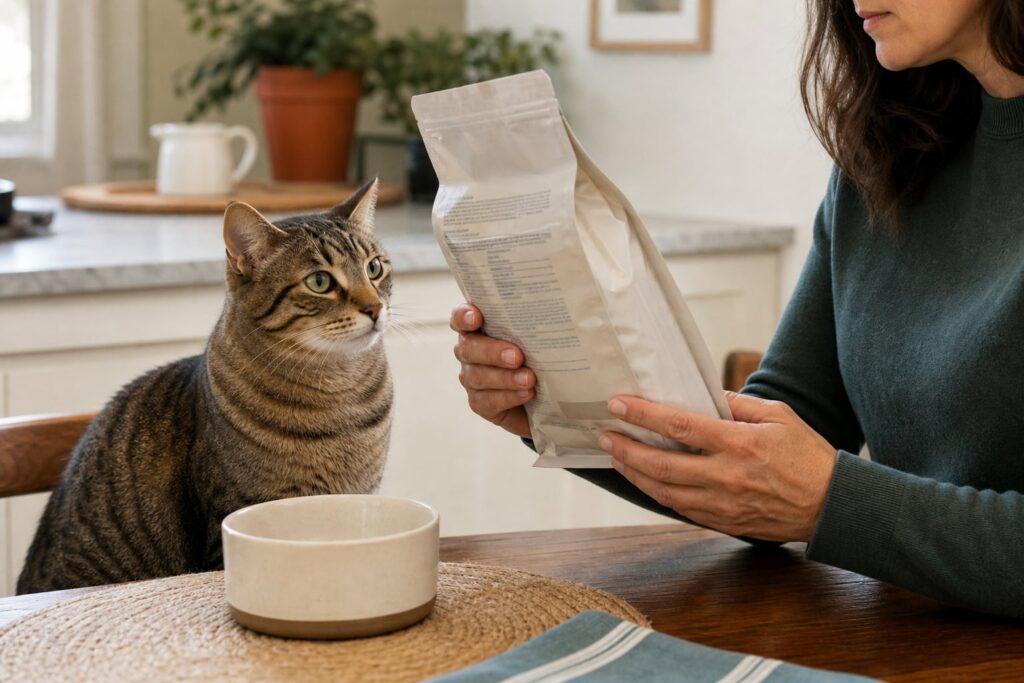
If you chose raw food because you wanted to give your cat something thoughtful, natural-feeling, and nourishing, this is not a lecture. It is a safety update. Good care sometimes means changing course when new evidence changes the risk around a familiar choice.
The conversation about raw cat food and bird flu has changed. Federal health agencies now advise cat owners not to feed raw pet food or unpasteurized milk because contaminated animal products can transmit H5N1 to cats. Infection is not inevitable, and there is no evidence that every raw product is contaminated. But documented food-linked cases show that the route is real, and illness in cats can be severe.
This guide separates what officials have confirmed from what remains uncertain, explains what may count as raw, and gives you a calm plan for checking the food in your home.
The quick answer for cat parents
A safer current default is a heat-treated cat food that is complete and balanced for your cat’s life stage. The Centers for Disease Control and Prevention advises against feeding pets raw pet food or raw milk. The Food and Drug Administration says cooking, canning, and pasteurization are processing steps capable of inactivating H5N1.
Fact-check date: July 30, 2026. On the date this guide was checked, an FDA notice about RAWR Raw Cat Food Chicken Eats identified two affected frozen-product lots:
- Lot CCS 25 077, with a sell-by date of 09/18/26.
- Lot CCS 25 093, with a sell-by date of 10/03/26.
FDA reported that testing found H5N1 in these lots. Whole-genome sequencing suggested that virus detected in the food and in a cat that ate lot CCS 25 093 came from a common source of contamination. That cat became ill and was euthanized.
Because both the investigation and product guidance can be updated, check the FDA notice itself before acting on a package in your freezer. Match the full product name, lot code, and sell-by date. Do not assume a different recipe or lot is included, and do not assume that the absence of a listed lot makes every raw product risk-free.
Why H5N1 matters in a cat-food decision
H5N1 is an influenza A virus associated primarily with birds, but it can infect mammals. Cats appear particularly vulnerable to serious disease after certain exposures. In the United States, many feline infections have been associated with affected farms or contact with infected animals. Some have been linked to commercially produced raw pet food and unpasteurized milk.
Food becomes a possible route when ingredients from infected poultry or cattle are used without a step capable of inactivating the virus. In response, the FDA told covered pet-food manufacturers using uncooked or unpasteurized poultry or cattle ingredients to treat H5N1 as a known or reasonably foreseeable hazard when reanalyzing their food-safety plans. That regulatory action does not mean every product contains the virus. It means the hazard is credible enough that prevention cannot rest on hope.
A 2026 CDC investigation adds important context. Nineteen cats from five Los Angeles County households became ill after reported exposure to commercially purchased raw milk, raw poultry, raw meat, or raw pet food. Fourteen died or were euthanized. Nine cats were tested, and all nine tested positive for H5N1. This was an investigated group of affected cats, not a random sample of all raw-fed cats, so those numbers must not be turned into a general fatality rate or a prediction for an individual pet.
The compassionate conclusion is neither “panic” nor “ignore it.” The probability that any one unlisted package is contaminated is not provided by these investigations. The possible consequence for an exposed cat is serious enough, however, that federal agencies recommend avoiding raw animal products.
What counts as raw may surprise you
Raw does not always look like meat from a butcher’s counter. It can arrive as a frozen patty, a shelf-stable morsel, a powdery topper, or a treat. According to CDC pet-food guidance, raw animal protein may appear in several forms:
- Fresh or refrigerated uncooked meat and organs.
- Frozen raw meals, patties, nuggets, or sliders.
- Freeze-dried raw meals, toppers, and treats.
- Dehydrated products that have not received a pathogen-killing heat treatment.
- Uncooked eggs or products containing them.
- Raw, unpasteurized milk or dairy products.
Freezing is useful storage, but it should not be treated as sterilization. CDC notes that freezing, freeze-drying, and dehydrating raw animal protein do not eliminate every germ. A food can therefore be frozen solid or dry enough to sit on a shelf and still be considered raw.
Do not decide from texture alone. Read the preparation language and ask the manufacturer what validated step is used to control pathogens. “Natural,” “fresh,” “minimally processed,” and “high protein” do not answer that question. Our pet food label guide can help you find the nutritional adequacy statement, life-stage claim, manufacturer details, lot code, and storage directions without treating front-of-package language as proof.
A five-minute check of your freezer and pantry
You do not need to empty the kitchen in alarm. Work methodically, one package at a time.
- Identify the exact product. Record the brand, recipe, form, package size, and whether it is frozen, freeze-dried, dehydrated, canned, or cooked.
- Find the lot code and sell-by date. They may be printed near a seam, on the back, or beside the date. Photograph the entire panel so you retain the context.
- Compare the package with the current FDA notice. Match every character you can read. A similar name is not enough to confirm that your package is included.
- Keep the original packaging. The lot code, manufacturer, date, and product identity are useful if a veterinarian, company, or regulator needs to investigate.
- Review the rest of the feeding routine. Include raw toppers, treats, milk, eggs, and food shared from another pet’s bowl. Small extras can be easy to forget.
If a package matches an affected lot, stop feeding it and follow the current official notice and manufacturer instructions. Avoid opening or handling it more than necessary. Do not feed it to another animal, and do not continue using it merely to finish a gradual food transition.
If the package does not match, that answers only the lot question. You can still use the wider guidance to reconsider raw animal products with your veterinarian and choose a practical heat-treated alternative.
If your cat has already eaten raw food
Feeding raw food once does not mean your cat will become ill. It also does not create a useful reason to blame yourself. Focus on the information that can guide the next decision.
- Stop further exposure if the product is named in an official notice or if you cannot confidently identify it.
- Save photographs of the product, lot code, sell-by date, receipt if available, and feeding directions.
- Write down when your cat ate it, approximately how much was eaten, and whether other pets received the same food.
- Contact your veterinarian for individual advice if the package matches a notice, there was another credible H5N1 exposure, or your cat seems unwell.
- Tell the clinic about raw-food, raw-milk, farm, or wild-bird exposure before arriving so the team can plan safe care.
Do not try to diagnose H5N1 at home, provoke vomiting, or start leftover medication. Do not force-feed a cat who is struggling to breathe, cannot coordinate movement, or is otherwise acutely unwell. Those situations need professional direction.
Warning signs that deserve prompt veterinary care
Possible H5N1 signs overlap with many other feline illnesses. They can include fever, unusual tiredness, reduced appetite, red or inflamed eyes, discharge from the eyes or nose, and difficulty breathing. Neurologic changes can include tremors, seizures, poor coordination, circling, or sudden vision problems.
These signs do not confirm bird flu. A cat with poor appetite might have dental pain, nausea, kidney disease, stress, or another condition. Eye or respiratory signs can also have several causes. Exposure history is what makes the food package, lot code, and timing so valuable to the veterinary team.
Call promptly if signs appear after a known or possible raw-animal-product exposure. Breathing difficulty, seizures, collapse, marked disorientation, or inability to stand warrants urgent veterinary help. If your cat simply refuses a replacement food, do not wait indefinitely for hunger to win. Cats need dependable nutrition, and a veterinarian can help you change course without allowing a safety decision to become an appetite crisis.
Choosing a safer replacement without losing the nutrition plot
“Raw” describes processing; it does not prove that a diet is complete, balanced, digestible, or better suited to a particular cat. In the same way, “cooked” does not automatically make every food nutritionally appropriate. Food safety and nutritional adequacy are two separate questions, and a thoughtful replacement should address both.
Start with a product carrying a complete-and-balanced nutritional adequacy statement for your cat’s life stage. FDA explains that this wording means the food is intended to serve as the sole diet and is supported through an applicable nutrient profile or feeding-trial route. It is not a pathogen-testing seal, but it is more informative than relying on an ingredient list or a “premium” promise.
A canned food has undergone heat processing and can offer substantial moisture. A conventional dry food is also heat processed and may be easier for some households to store and measure. Some cats do well with a combination. The right format is the one your cat will reliably eat, that your household can handle safely, and that meets the cat’s nutritional and medical needs. Our cat food selection guide and cat food catalog can help you organize those questions without declaring one format universally best.
For a healthy cat eating a product that is not subject to a stop-feeding notice, a gradual transition may help acceptance. If an official notice says not to feed a product, safety takes priority; ask your veterinarian how to replace it without continuing the affected food. Do not cook a commercial raw formula on your own unless its manufacturer explicitly designed it for that preparation and your veterinarian agrees. Heating a product containing ground bone or relying on an improvised recipe can introduce different problems.
Protecting people and other animals at home
CDC says it is unlikely for a person to get bird flu from an infected pet, but it is possible, and close unprotected exposure deserves care. A 2026 investigation found serologic evidence compatible with possible H5N1 infection in one asymptomatic veterinary professional exposed to an infected cat. That finding does not show that cat-to-human spread is common, but it reinforces the value of infection control.
Raw food also carries broader foodborne-germ concerns beyond H5N1. Sensible household precautions include:
- Wash hands with soap and water before and after handling pet food.
- Clean and disinfect bowls, utensils, counters, refrigerator surfaces, and anything touched by raw food, following product-label directions.
- Keep raw animal products sealed and separate from human food.
- Thaw frozen food in the refrigerator, not on a counter, and discard leftovers according to official or manufacturer guidance.
- Do not let a cat lick faces, mouths, broken skin, or open wounds after eating.
- Keep cats away from sick or dead wild birds, poultry, and their droppings, and discourage hunting.
If a cat with a credible exposure becomes ill, minimize close face-to-face contact and call the veterinary clinic rather than improvising isolation or protective equipment. People who develop illness after contact with a suspected or confirmed infected animal should seek advice from a human healthcare professional or public-health authority.
A calm way forward
You do not have to choose between loving your cat and admitting that a feeding choice deserves another look. The most pet-centered response is simple: check the package, use current official information, avoid raw animal products under present federal guidance, and choose a heat-treated diet that is nutritionally appropriate and realistic for your home.
The evidence does not support saying that every raw product is contaminated or that every exposed cat will become sick. It does support taking the documented route seriously. Keep the lot code. Watch the cat, not the internet rumor mill. Call your veterinarian when exposure or symptoms make the question personal. Care is not about never changing your mind; it is about noticing when your cat needs you to.
Sources
- U.S. Food and Drug Administration: H5N1 contamination notice for certain RAWR Raw Cat Food Chicken Eats lots
- U.S. Food and Drug Administration: H5N1 in cat- and dog-food safety plans
- Centers for Disease Control and Prevention: bird flu in pets and other animals
- Centers for Disease Control and Prevention: 2026 MMWR investigation of infected domestic cats and exposed people
- Centers for Disease Control and Prevention: pet-food safety and raw pet food
- U.S. Food and Drug Administration: complete-and-balanced pet food
Keep exploring
Next reads and tools
Next route
Browse products
Move from article context into real formula review when you want to compare options.
Open routeIngredient context
Inspect ingredients
Use the ingredient library when one concept in the article needs label-level context.
Open routeTrust boundary
Review methodology
See how scoring, interpretation, and explanation boundaries work across the platform.
Open route