Blue Buffalo · Food
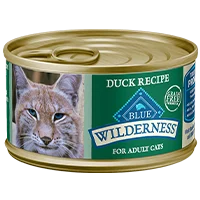
Blue Buffalo Wilderness™ Wet Cat Food - Duck
- Cat
- Wet
- Adult
- Protein
- 10% min
- Fat
- 8% min
- Fiber
- 1.5% max
- Moisture
- 78% max
Facts read from bluebuffalo.com, checked November 2, 2026. Labels change: check the package before you buy.
Ingredients
- 1 Duck
- 2 Chicken
- 3 Chicken Liver
- 4 Turkey Broth
- 5 Potatoes
- 6 Flaxseed
- 7 Natural Flavor
- 8 Guar Gum
- 9 Sodium Acid Pyrophosphate
- 10 Potassium Chloride
- 11 Taurine
- 12 Choline Chloride
- 13 Carrageenan
- 14 Cassia Gum
- 15 Salt
- 16 Iron Amino Acid Chelate
- 17 Zinc Amino Acid Chelate
- 18 Vitamin E Supplement
- 19 Niacin Supplement (Vitamin B3)
- 20 Thiamine Mononitrate (Vitamin B1)
- 21 Copper Amino Acid Chelate
- 22 Manganese Amino Acid Chelate
- 23 Sodium Selenite
- 24 Vitamin A Supplement
- 25 Calcium Pantothenate (Vitamin B5)
- 26 Vitamin B12 Supplement
- 27 Riboflavin Supplement (Vitamin B2)
- 28 Pyridoxine Hydrochloride (Vitamin B6)
- 29 Biotin (Vitamin B7)
- 30 Folic Acid (Vitamin B9)
- 31 Potassium Iodide
- 32 Vitamin D3 Supplement
In label order: by weight before cooking, heaviest first. Underlined ingredients have a glossary entry.
Guaranteed analysis
| Nutrient | On the label | Dry matter (calculated) |
|---|---|---|
| Crude Protein | 10% min | 45.5% |
| Crude Fat | 8% min | 36.4% |
| Crude Fiber | 1.5% max | 6.8% |
| Moisture | 78% max | — |
| Taurine | 0.1% min | 0.5% |
Dry matter takes the water out (value ÷ (100 − moisture) × 100), so wet and dry foods can be compared on one scale.
Calories
- per kg
- 1,330 kcal
- per can
- 113 kcal
The label says: “Calorie Content: 1,330 kcal/kg, 113 kcal/can.”
Against the AAFCO minimums
The label's guaranteed minimum, next to the minimum AAFCO sets for cats, adult maintenance.
- protein75.2 g vs 65 g minimumAbove
- fat60.2 g vs 22.5 g minimumAbove
Per 1,000 kcal, the way AAFCO writes its profiles. Meeting a minimum doesn't make a food right for your pet: ask your veterinarian. How this is worked out
Carbohydrates and calories (estimates)
About 3.4% of the dry matter is carbohydrate, worked out by difference: labels don't state it. The label states no ash, so 8% of dry matter is assumed (a typical value).
- Protein 33%
- Fat 64%
- Carbohydrate 2%
Where the calories come from, with the modified Atwater factors (3.5, 8.5 and 3.5 kcal per gram).
More from Blue Buffalo
Blue Buffalo
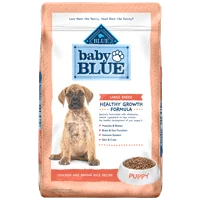
Blue Buffalo Baby BLUE Chicken & Brown Rice Large-Breed Puppy Food
Protein 26% · Fat 15% · 3,628 kcal/kg
Blue Buffalo
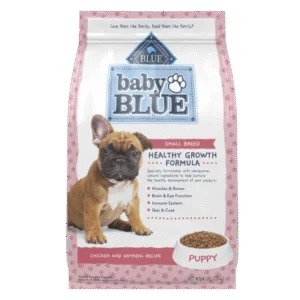
Blue Buffalo Baby BLUE Chicken & Oatmeal Small-Breed Puppy Food
Protein 29% · Fat 17% · 3,731 kcal/kg
Blue Buffalo
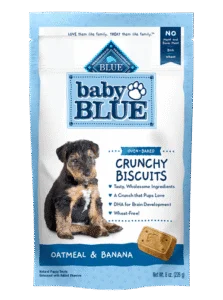
Blue Buffalo Baby BLUE Crunchy Puppy Treats
Protein 12% · Fat 5% · 3,470 kcal/kg
Blue Buffalo
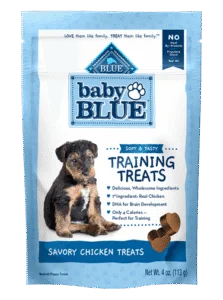
Blue Buffalo Baby BLUE Puppy Training Treats
Protein 10% · Fat 7%