Wellness · Food
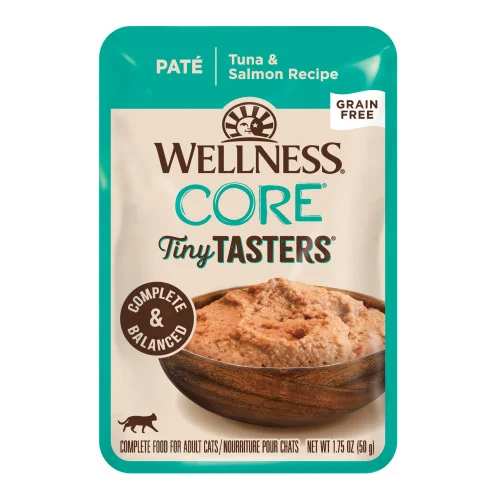
Wellness CORE Tiny Tasters Pate Tuna & Salmon Recipe
- Cat
- Wet
- Protein
- 12% min
- Fat
- 3.5% min
- Fiber
- 1% max
- Moisture
- 78% max
Facts read from wellnesspetfood.com, checked November 2, 2026. Labels change: check the package before you buy.
Ingredients
- 1 Tuna
- 2 Fish Broth
- 3 Water Sufficient for Processing
- 4 Salmon
- 5 Sunflower Oil
- 6 Tapioca Starch
- 7 Natural Flavors
- 8 Tricalcium Phosphate
- 9 Locust Bean Gum
- 10 Potassium Chloride
- 11 Guar Gum
- 12 Salt
- 13 Sodium Carbonate
- 14 Taurine
- 15 Xanthan Gum
- 16 Vitamins (Vitamin E Supplement, Thiamine Hydrochloride, Niacin, Vitamin A Supplement, Pyridoxine Hydrochloride, d-Calcium Pantothenate, Riboflavin Supplement, Folic Acid, Vitamin D3 Supplement, Biotin, Vitamin B12 Supplement)
- 17 Magnesium Sulfate
- 18 Choline Chloride
- 19 Zinc Amino Acid Chelate
- 20 Menadione Sodium Bisulfite Complex (Vitamin K)
- 21 Iron Amino Acid Chelate
- 22 Copper Amino Acid Chelate
- 23 Manganese Amino Acid Chelate
- 24 Sodium Selenite
- 25 Potassium Iodide
In label order: by weight before cooking, heaviest first. Underlined ingredients have a glossary entry.
Guaranteed analysis
| Nutrient | On the label | Dry matter (calculated) |
|---|---|---|
| Crude Protein | 12% min | 54.5% |
| Crude Fat | 3.5% min | 15.9% |
| Crude Fiber | 1% max | 4.5% |
| Moisture | 78% max | — |
| Taurine | 0.1% min | 0.5% |
Dry matter takes the water out (value ÷ (100 − moisture) × 100), so wet and dry foods can be compared on one scale.
Calories
Not stated on the maker's page.
Against the AAFCO minimums
The label's guaranteed minimum, next to the minimum AAFCO sets for cats, adult maintenance.
- protein54.5 % vs 26 % DM minimumAbove
- fat15.9 % vs 9 % DM minimumAbove
On a dry matter basis (the label states no calories). Meeting a minimum doesn't make a food right for your pet: ask your veterinarian. How this is worked out
Carbohydrates and calories (estimates)
About 17% of the dry matter is carbohydrate, worked out by difference: labels don't state it. The label states no ash, so 8% of dry matter is assumed (a typical value).
- Protein 50%
- Fat 35%
- Carbohydrate 15%
Where the calories come from, with the modified Atwater factors (3.5, 8.5 and 3.5 kcal per gram).
More from Wellness
Wellness
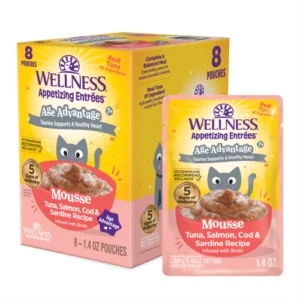
Wellness Appetizing Entrees Age Advantage Mousse Tuna, Salmon, Cod & Sardine Recipe Infused with Broth
Protein 10% · Fat 2%
Wellness
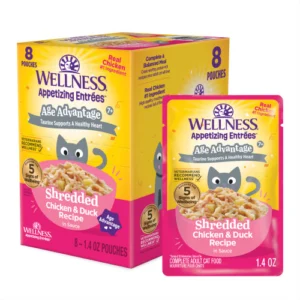
Wellness Appetizing Entrees Age Advantage Shredded Chicken & Duck Recipe in Sauce
Protein 10% · Fat 2%
Wellness
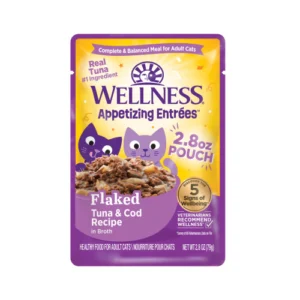
Wellness Appetizing Entrees Flaked Tuna & Cod Recipe in Broth
Protein 10% · Fat 3%
Wellness
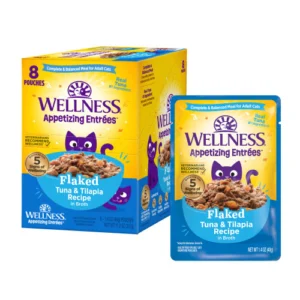
Wellness Appetizing Entrees Flaked Tuna & Tilapia Recipe in Broth
Protein 10% · Fat 3%